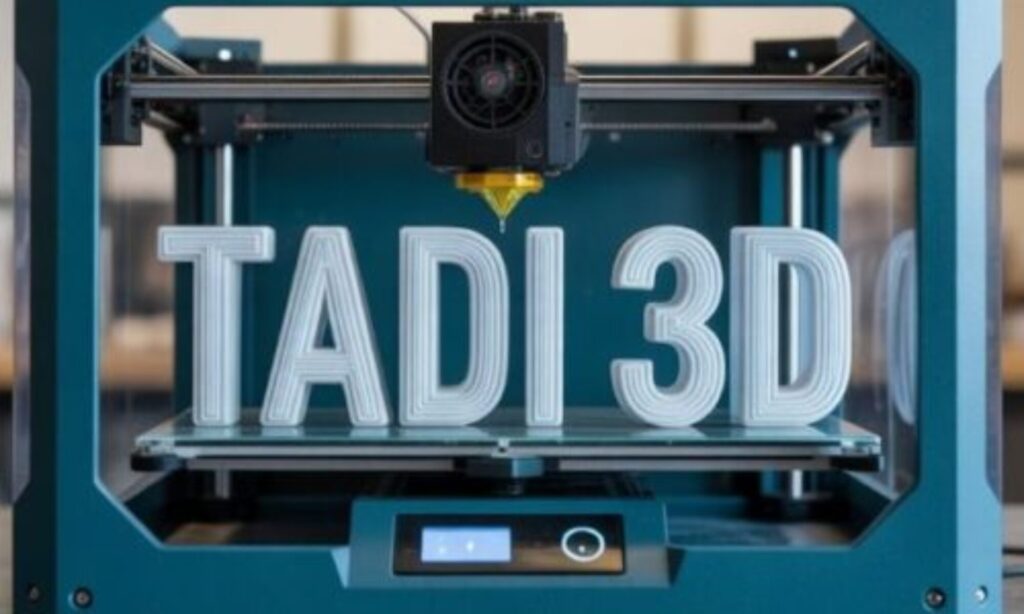
3D printing – the technology of the future that is already here
A 3D printing is one of the most exciting and innovative technologies of recent years. Although many still consider it a futuristic novelty, in fact we already encounter it every day – in industry, medicine, design and even in homes. In this article, we will explain what 3D printing is, how it works, what it is used for and why it is worth following its development.
What about 3D printing?
3D printing, also known as additive manufacturing, is a manufacturing process that builds an object layer by layer from a digital model. This process is completely different from traditional manufacturing methods, where something is carved, cut, or turned out of a raw material. additive manufacturing,a manufacturing process in which an object is built up layer by layer based on a digital model. This process is completely different from traditional manufacturing methods, where something is carved, cut or turned out of the raw material
The advantage of 3D printing is that almost any shape can be realized: complex structures, organic shapes, and even internal cavities and geometries that would be impossible to achieve with traditional methods.
How does 3D printing work?
The process consists of several steps:
- Creating a 3D model – The digital plan is created in CAD software or by 3D scanning.
- Slicing – The design is divided into layers by special software so that the printer knows exactly where and in what order to build the object.
- Printing – The printer dispenses material (e.g. plastic, metal, resin) from a nozzle, building up the final object layer by layer.
- Post-processing – In some cases, sanding, painting or heat treatment is necessary for the perfect final result.
What technologies exist?
There are several types of 3D printing, the most popular of which are:
- FDM (Fused Deposition Modeling): A cheap, accessible technology that uses plastic filament. It is the most common in home printers.
- SLA (Stereolithography): Uses a photosensitive resin that is hardened by laser or UV light. Very precise, but more expensive.
- SLS (Selective Laser Sintering): Powder-based printing where the material is fused together with a laser. Professional industrial solution.
- Metal printing (DMLS, EBM): Metal powder is fused together with a laser or electron beam, so even aircraft parts can be made.
Where is 3D printing used?
The application areas of 3D printing are constantly expanding. Some exciting examples include:
Engineers can create prototypes and test new ideas at lightning speed, reducing product development time and costs.
3D printing is revolutionizing healthcare: it is used to make unique prostheses, implants, surgical aids, and even research is being done into the printing of biological tissues and organs.
It is also possible to print houses, furniture and interior design elements. Complete houses have already been built from 3D printed concrete in China and Europe.
More and more schools are using 3D printers to teach STEM subjects, and hobbyists can create their own figures, accessories, or unique objects at home.
Surprising but true: there are already printers that make chocolate, pizza or pasta!
Advantages of 3D printing
Rapid prototyping – A product can be made in hours instead of days.
Cost-effectiveness – It is worth producing even in small series.
Customization – Objects that can be adapted to individual needs.
Sustainability – Less waste, precise use of raw materials.
Innovation – Új iparágak és lehetőségek nyílnak meg.
Challenges and disadvantages
Of course, 3D printing also has its limitations:
Industrial machinery and raw materials can still be expensive.
The printing speed is slow in some cases.
Expertise is required for design and post-processing.
The durability of some materials does not reach the level of traditional manufacturing.
The future of 3D printing
According to experts, the 3D nyomtatás forradalma még csak most kezdődik. It is expected in the coming years:
Faster and cheaper printers that will be widely available.
Bioprinting breakthroughs, i.e. printing human organs.
Fully automated factories where products are made with almost no human intervention.
Application in space exploration, where devices or buildings can be printed locally on planets.